.png)

-
Sky-high U.S. NFDM/SMP prices and ongoing shipping disruptions in the Middle East fail to blunt demand for U.S. milk powder, cheese, whey, and butterfat in April.
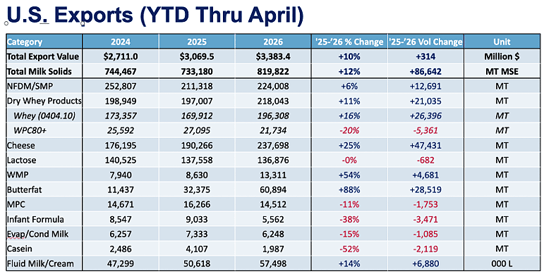
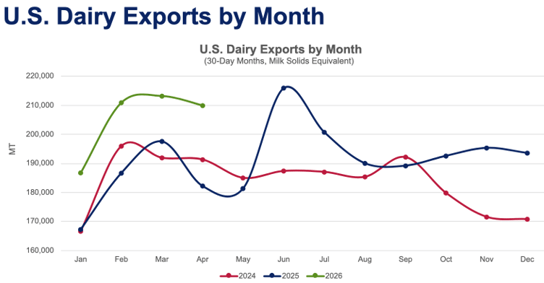
Year-over-year (YOY) U.S. dairy exports rose 15% in milk solids equivalent (MSE) terms in April. It was the seventh straight YOY increase, as global demand showed resilience in the face of elevated protein prices and supply chain disruptions.
While many unknowns await and concerns abound (war, trade tensions, economic stagnation, and inflation, to name a few), the year has begun at record pace. Through the first four months of 2026, U.S. exports grew nearly 12% to 819,822 MT MSE—far and away the best start to a year ever.
Growth was widespread among product sectors and geographies. April cheese exports set a new monthly record of 64,168 MT, a 30% increase over the previous year. The previous record—63,435 MT—was set just a month earlier, supplanting the former record of 58,406 MT set in February. In other words, U.S. suppliers have set new cheese export records for three straight months.
Gains remain widespread, led by Mexico (+28%, +4,909 MT) and South Korea (+69%, +3,758 MT). (For more on cheese to South Korea, see below.) The only potential red flag in April was an 11% decline in volume (-361 MT) to Australia—one of the hottest U.S. cheese export markets over the last year-plus. While U.S. cheese volume to Australia still cleared 3,000 MT for the month, it was the first YOY decrease to the country in more than a year.
Butterfat also continued its growth streak, with combined exports of butter and anhydrous milkfat (AMF) up 74% (+6,258 MT) YOY, driven by exponential growth to the Middle East/North Africa (see below for more details) and supported by smaller gains to markets across a broad geography, including Mexico (+1,057 MT).
The most surprising growth in April came from nonfat dry milk/skim milk powder (NFDM/SMP), which rose 9% (+4,877 MT) despite the deeply unfavorable U.S. pricing position compared to New Zealand and the EU. While U.S. suppliers saw small gains to assorted markets, the increase was driven primarily by the Philippines, where YOY volume rose 141% (+6,230 MT). U.S. NFDM/SMP volume has been buoyed by shipments contracted before U.S. prices went on their record-breaking run starting in January, and April’s growth is possibly carryover from those transactions. (For more on NFDM/SMP, see below.)
Low-protein whey recorded its best YOY growth of the 2026, with volume rising 39% to 52,097 MT and gains in all three subcategories—dry whey (HS 04041040), whey protein concentrate less than 80% (HS 04041005), and modified whey (HS 04041085)—which has been rare over the past couple years. It was the United States’ first increase in supply-constrained less-than-80% WPC since last July. However, dry whey was the star in April, with YOY volume jumping 62% (+10,391 MT), bolstered by triple-digit gains to China and Canada. (Note: USDEC adjusts whey volumes to China to reflect misclassified product.)
For more detailed information, as well as interactive charts and data, visit USDEC's Data Hub.
Butter finds new paths into the Gulf
Market conversations in recent weeks have been dominated by the war in the Middle East and its potential repercussions on dairy trade. April’s trade data sheds new light on how commerce in the region has adjusted to this new reality.As the Strait of Hormuz remains effectively closed, shippers have sought different paths to get product into the Gulf states, including bringing product into the port of Jeddah on the West Coast of Saudi Arabia and shipping it across the country. This is far from a simple fix, as limited infrastructure has created bottlenecks that are causing delays and dramatically increasing freight costs.
Nevertheless, April’s trade data suggests that this strategy is being employed as butter exports to Saudi Arabia soared to 1,747 MT, the highest monthly volume since 2014 and over 20 times more than was shipped in the same month last year. Saudi Arabia is an important destination for U.S. butter, but the sharp increase in April combined with weaker performance across other destinations in the region, suggests that the country likely served as a launch pad to move product into other countries. While volumes to Saudi Arabia towered, exports to other, more logistically vulnerable, destinations in the region wavered. U.S. butter shipments to Bahrain, Qatar, and Oman evaporated, while exports to the UAE slumped to just 1.4 MT.
These shifting volumes are a testament to sustained demand for U.S. milkfat in the region. Only time will tell if the conflict will be resolved and more historically typical trade flows will be restored. But for the moment, despite immense challenges, the Middle East continues to play a key role in boosting U.S. butter exports.
The Philippines lifts powder exports
U.S. nonfat dry milk prices began their ascent in early January, and U.S. suppliers quickly found themselves at an elevated price compared to the global competition. At the core of this increase lay scarce supplies, as protein has been methodically routed away from the dryer and toward other uses in recent months and years. Considering these factors, the 9% (+4,877 MT) increase in U.S. nonfat dry milk exports in April came as a surprise. But a closer look at the data reveals choppy performance across destinations and suggests that U.S. milk powder exports are likely to remain under pressure over the coming months even as production is rebounding.U.S. NFDM/SMP exports to Southeast Asia rose 39% (+4,910 MT) in April, an impressive result for a price-sensitive and fiercely contested region. However, nearly all the increase was driven by stronger shipments into the Philippines, which saw volumes more than double (+141%, +6,230 MT) against last year’s anemic figures. However, the good news ended there as volumes into nearly every other country in the region fell. Of particular note was a 36% (-821 MT) dip in product to Malaysia and a 69% (-551 MT) decline in volumes to Singapore.
Why were such strong exports to the Philippines able to prevail in the face of such strong headwinds? Importantly, it appears that Filipino buyers did not feel the impact of higher prices. The unit price of NFDM/SMP shipped to the Philippines in April was just $2,800/MT, or an equivalent of $1.27/lb., only slightly higher than the January value and a 17% discount to the global average. Whether due to previously negotiated contracts or other commercial arrangements, this is not sustainable in perpetuity and higher prices in the future are likely to dampen U.S. export prospects to the country and the region.
South Korea’s voracious appetite lifts cheese exports
While global cheese demand continues to expand, South Korea’s appetite remains particularly significant for U.S. suppliers. U.S. cheese exports to South Korea soared by 69% (+3,758 MT) year over year in April. While slightly behind March’s all-time-high performance, April’s result was nevertheless the second largest seen since the pandemic and has placed the country firmly on track for record-setting performance this year. Over the first four months of 2026, U.S. suppliers have sent 31,837 MT of cheese to South Korea, the largest volume ever posted for the period, handily beating the prior record set in 2019 by 22%.Shifting consumer tastes and stronger-than-expected economic performance have likely supported Korean demand early in 2026. Data from the country’s central bank showed that GDP rose 1.8% in the first quarter, slightly above expectations. Despite persistent risk from rising energy prices, improved economic performance is boosting consumer confidence and driving cheese demand, especially through the foodservice segment.
As mentioned in previous export blogs, to account for misclassified product, USDEC continues to adjust U.S. WPC80+ export volume and value.
Learn more about global dairy markets
- March makes it six straight months of year-over-year export growth
- U.S. extends dairy export growth streak in February
- Dairy exports start strong in 2026
- Big December lifts annual U.S. dairy export growth to +4%
Subscribe to the U.S. Dairy Exporter Blog
The U.S. Dairy Export Council fosters collaborative industry partnerships with processors, trading companies and others to enhance global demand for U.S. dairy products and ingredients. USDEC is primarily supported by Dairy Management Inc. through the dairy farmer checkoff. How to republish this p