.png)

-
Cheese and butterfat continue to propel U.S. dairy trade even as four-month NFDM/SMP growth streak ends.
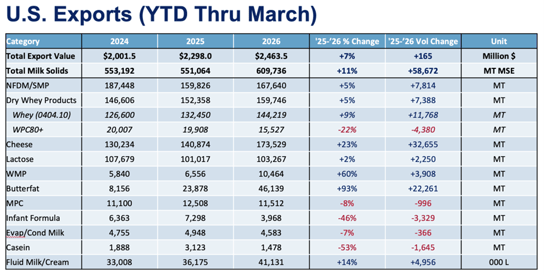
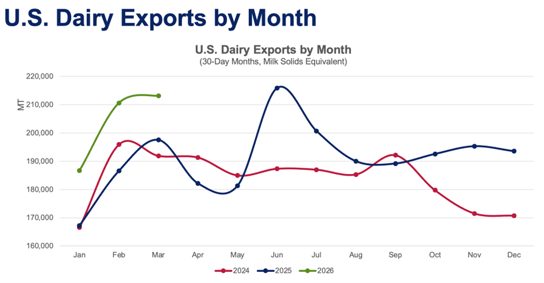
Year-over-year (YOY) U.S. dairy exports grew 8% in March in milk solids equivalent (MSE) terms, as cheese and butterfat continued to drive volume. It was the sixth straight month of YOY growth, and MSE volume was the highest since May 2022.
Exports have started the year blazing hot, with volume rising nearly 11% in the first quarter.
March cheese, butter and powder
U.S. cheese and butterfat exports each set new single-month records in March. Cheese shipments jumped 29% to a never-before-seen 63,435 MT (+14,148 MT). Combined exports of butter and AMF soared 110% to a lofty 17,074 MT (+8,940 MT).Gains were geographically widespread for both products. Cheese shipments to our top two markets—Mexico and South Korea—rose an impressive 40% (+6,200 MT) and 79% (+ 4,651 MT), respectively. On the butterfat side, shipments to the Middle East/North Africa rose 361% (+2,672 MT), volume to South Korea increased 364% (+1,691 MT), and exports to Mexico gained 98% (+1,533 MT). (For first quarter product overviews, see sections below.)
Things were a little more downbeat in nonfat dry milk/skim milk powder (NFDM/SMP). U.S. NFDM/SMP exports fell to our top two customers in March, with Mexico down 7% (-2,295 MT) and Southeast Asia falling 6% (-1,907 MT). While March NFDM/SMP volume was the highest of the past five months, the prior March was the biggest month of 2025 at 64,575 MT. (By contrast, volumes from December 2024-February 2025 were all below 50,000 MT.) So, after four straight YOY monthly gains, U.S. exports dropped back into the red in March. Volume fell 8% (-5,052 MT) to 59,522 MT.
Impact of Middle East conflict begins
Ahead of the release of March data, the big unknown was how quickly the conflict with Iran and closure of the Strait of Hormuz would impact U.S. exports to the Middle East. March numbers suggest the fighting took an immediate toll on U.S. dairy trade in the region.The most obvious example is Bahrain, which began ramping up U.S. butter purchasing in the last quarter of 2025. The United States exported 3,480 MT of butter to Bahrain in the fourth quarter (from zero the year prior), then another 1,701 MT in the first two months of 2026. Then in March, U.S. butter shipments to Bahrain fell to zero.
By contrast, the United States shipped 1,893 MT of butterfat to Saudi Arabia MT in March, up 221% from the previous year, but how much actually landed in the country is unknown.
YOY U.S. cheese shipments to the Middle East fell 37% in March (-893 MT). But volume declined 21% (-1,178 MT) over the first two months of the year, so it remains unclear how much of March’s decline can be attributed directly to the fighting.
More clarity on the conflict’s effect on dairy trade in the region should come with April data.
For more detailed information, as well as interactive charts and data, visit USDEC's Data Hub.
U.S. cheese exports defy the odds
Extraordinary. Remarkable. Stellar. We may be running out of adjectives to describe U.S. cheese export performance which has been on a tear since 2024. Unfazed by lofty comparison volumes last year, cheese exports during the first quarter continued to soar with shipments up 23% (+32,655 MT) during the first three months of the year. An all-time high set in February was quickly bested by an even larger 63,435 MT performance in March— the first time that U.S. cheese shipments have risen above the 60,000 MT threshold in a single month.Encouragingly, a broad swath of destinations continue to support U.S. cheese exports, though a few geographies stand out. Latin America in particular, continues to impress with Q1 volumes up 34% (+14,862 MT) to Mexico while Central America and the Caribbean saw a 26% (+6,139 MT) increase during the first quarter. Stronger shipments to Asia also played a role with South Korea distinguishing itself as the star. U.S. cheese exports to Korea were up 29% (+5,096 MT) in Q1, including March’s impressive figure.
Such historically strong performance sets a high bar. Even so, the U.S. remains poised to defend strong cheese export volumes through the balance of the year. U.S. cheese remains affordable with respect to international competitors, even as prices have fallen. Furthermore, it seems likely that U.S. cheese will remain competitively priced, as robust milk production and capacity expansion keep cheese plentiful. On the other side of the ledger, the undercurrents of rising global demand that have expanded the appetites of cheese consumers across the world appear poised to persist … though a resurgence in inflation could generate headwinds later in the year.
Powder exports face pressure
After an inspiring start to the year, U.S. NFDM/SMP exports came under pressure during March, sliding to just 59,522 MT. Lack of supply and high prices are the likeliest culprit behind the regression as skim solids move out of the dryer and towards cheese, ultrafiltered milk, and other protein-heavy products. Volumes to Mexico declined by 7% (-2,295 MT) and South America witnessed a 32% dip (-1,951 MT). Southeast Asia, which had been a positive force for U.S. powder exports in recent months, also saw volumes slip by 6% (-1,097 MT). While the gains in January and February were sufficient to deliver a 5% (+7,814 MT) increase over the first quarter, March’s dip appears to be a harbinger of intensifying challenges for milk powder exports over the coming months.The dramatic runup in U.S. nonfat dry milk prices in recent weeks has simply rendered U.S. product uncompetitive against alternative suppliers outside of North America. While precontracted volumes will certainly keep some loads moving, the ability for the U.S. to maintain share is limited without a price reduction or sudden price rally out of Europe and/or Oceania.
That said, the market is responding and production of milk powder has risen in recent months in reaction to higher prices. But with competition for protein expected to remain fierce, milk powder production is unlikely to return to the highs seen in 2024 let alone the record peaks of 2021. As such, we anticipate limited supply will keep NFDM/SMP export volumes relatively constrained.
High WPC prices curb exports
In the era of health consciousness and rising GLP-1 usage, whey protein concentrates have been in high demand both domestically and abroad. However, recent months have seen demand rise beyond processing capacity, sending prices soaring. After seven straight months of price increases, export values of WPC80+ now sit above $16,400/MT, a 35% increase since last year.In Q1, we saw high prices begin to impact export volumes— shipments of WPC80+ fell 22% (4,380 MT), with volumes dropping 28% in March alone as prices ballooned. The largest Q1 volume declines were seen in China (-54%, -1,763 MT) and Japan (-28%, -1,417 MT), but exports fell to nearly every destination. However, Mexico and New Zealand bucked the trend with volumes rising 159% (+387 MT) and 157% (+326 MT), respectively.
Seemingly insatiable domestic demand for dairy proteins is limiting exportable supply for WPC80+ with U.S. inventories of WPC80 12% lower than prior-year levels even as production continues to climb. With an abundance of new product launches featuring whey proteins in the U.S., rising consumer awareness around the benefits of dairy protein, and GLP-1 usage significantly higher in the U.S. than in other countries, domestic demand for WPCs will likely remain strong even at higher prices. As such, U.S. WPC80+ exports are not anticipated to grow significantly until new processing capacity comes online later in the year.
Butterfat keeps rolling
While the Middle East and North Africa have been major drivers of growth in butterfat exports this year, the region is far from the only contributor. In March, demand surged in several key markets, boosting U.S. butter exports even higher than impressive 2025 levels (+77%, +8,940 MT). Latin American demand for American butterfat, specifically Mexico, Central America, and the Caribbean, seems nigh insatiable. U.S. exports of butterfat to Mexico almost doubled in March (+98%, +1,533 MT) and almost tripled to Central America and the Caribbean (+178%, +888 MT). U.S. shipments have also been crossing the Pacific, as exports to South Korea have grown at an exponential rate, up 364% in March alone (+1,637 MT).With U.S. prices retaining their global competitiveness, U.S. exports of butter and AMF are expected to continue growing in the near term. That said, the expectation of weaker sales to the Arabian peninsula (with the closure of the Strait of Hormuz) and Europe (with converging global prices) will present headwinds to U.S. butter markets unless the U.S. is able grow exports to alternative markets like Korea, Latin America, and Oceania.
As mentioned in previous export blogs, to account for misclassified product, USDEC continues to adjust U.S. WPC80+ export volume and value.
Learn more about global dairy markets
- U.S. extends dairy export growth streak in February
- Dairy exports start strong in 2026
- Big December lifts annual U.S. dairy export growth to +4%
- U.S. dairy exports poised for strong finish to 2025
Subscribe to the U.S. Dairy Exporter Blog
The U.S. Dairy Export Council fosters collaborative industry partnerships with processors, trading companies and others to enhance global demand for U.S. dairy products and ingredients. USDEC is primarily supported by Dairy Management Inc. through the dairy farmer checkoff. How to republish this p