.png)

-
Broad gains across most product categories overcome a plunge in NFDM/SMP volume and reduced high-protein whey shipments.
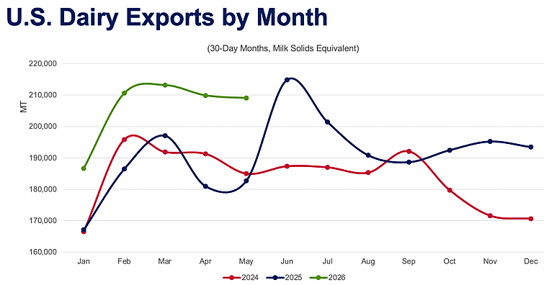
Year-over-year U.S. dairy exports grew 14% in milk solids equivalent (MSE) terms in May, despite supply chain disruptions in the Middle East, tight U.S. high-protein whey supplies, and sky-high (at the time) U.S. nonfat dry milk/skim milk powder (NFDM/SMP) prices. The increase, which speaks both to the strength of global demand and the commitment of U.S. suppliers to international markets, ran the U.S. dairy export growth streak to eight consecutive months.
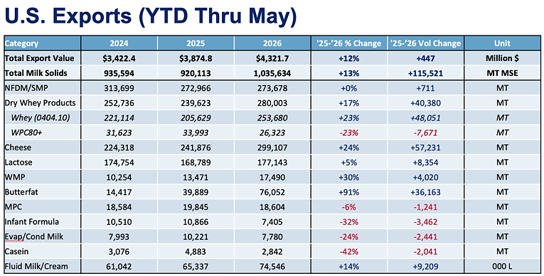
Year-to-date through May, U.S. MSE exports rose 12.6% compared to the previous year, while U.S. dairy export value grew 12% (+$447 million) to $4.32 billion.
Cheese, butterfat and the Middle East
While May showed widespread growth across product categories, the key drivers remained cheese and butterfat. We can’t say cheese set a volume record in May (as it did in each of the previous two months), but U.S. exports topped 60,000 MT for the third straight month.Year-over-year (YOY) shipments increased 18% to 61,409 MT in May, with widespread growth across geographies. South Korea (+52%, +3,495 MT) and Mexico (+16%, +2,629 MT) recorded the highest volume gains, as they have most of the year. Year-to-date, U.S. cheese exports to South Korea jumped 41% (+12,234 MT) and Mexico increased 29% (+22,393 MT).
YOY butterfat exports (butter plus anhydrous milkfat or AMF) more than doubled to 15,158 MT in May. As with cheese, U.S. suppliers saw diverse geographic expansion. Shipments to the Middle East/North Africa (767%, +2,700 MT) led the gain, but Australia, Mexico and Canada each increased May volume by more than 1,000 MT.
As butterfat performance suggests, U.S. suppliers continued to successfully work around shipping challenges to the Middle East caused by the closure of the Strait of Hormuz. The bulk of U.S. butter and cheese shipments to the Middle East is now moving through Saudi Arabia, a shift originally noted in USDEC’s April trade data analysis. May numbers added further evidence of that shift.
YOY U.S. butterfat shipments to Saudi Arabia grew 473% (+1,458 MT) in May, while exports to Bahrain—a rising U.S. butter buyer—remained at zero for the second straight month. U.S. cheese shipments to Saudi Arabia soared 176% (+1,570 MT) in May, while combined volume to Bahrain, Kuwait, Oman, Qatar, and the UAE dropped 68% (-751 MT). U.S. exports to the region have continued to rise despite the conflict and the supply chain challenges. The results raise the question: What might growth have been like without the logistical challenges?
For more detailed information, as well as interactive charts and data, visit USDEC's Data Hub.
Low-protein whey rises, but for how long?
U.S. exports of low-protein whey continued to gain momentum in May. Monthly YOY growth has steadily risen from +7% in January to +56% (+20,520 MT) in May. (Note: USDEC adjusts whey volumes to China to account for misclassified product.) Total low-protein whey exports in May were the highest so far this year at 57,164 MT.Increased shipments to China in May (+282%, +18,918 MT) were the primary reason. But that gain is significantly inflated by the bottom falling out of U.S. whey shipments to China in the spring of 2025. The U.S. exported only 6,707 MT to China in May 2025 due to tariff uncertainties and trade tensions at the time, well below average monthly volumes. U.S. low-protein whey exports to China returned to normal in June 2025, so growth is likely to come back down to earth once USDA publishes June numbers.
NFDM/SMP already comes back to earth
U.S. NFDM/SMP exports surprised almost everyone in April by growing 6% over the previous year, despite sky-high U.S. NFDM/SMP prices. The increase derived almost completely from a huge buying month in the Philippines, where shipments rose 141% (+6,230 MT). USDEC speculated that such a prodigious rise during an unfavorable period of pricing was likely due to product contracted prior to U.S. NFDM/SMP price escalation throughout the first few months of the year.With the release of the May numbers, we see that our assessment was likely accurate. YOY U.S. exports of NFMD/SMP plunged 20% in May (-12,451 MT). Shipments to our top market, Mexico, dropped 13% (-4,638 MT) and volume to our No. 2 market, Southeast Asia, declined 11% (-1,665 MT). The Philippines was again one of the few markets to record a gain (albeit more modest than April), with May volume up 20% YOY (+1,079 MT).
While U.S. NFDM/SMP prices are still slightly above the EU and New Zealand, they have come back down to earth over the course of June, which (when coupled with improving production volume so far this year) provides a glimmer of export optimism for the latter months of 2026.
As mentioned in previous export blogs, to account for misclassified product to China, USDEC continues to adjust U.S. whey export volume and value.
Learn more about global dairy markets
- U.S. export growth streak runs to seven months
- March makes it six straight months of year-over-year export growth
- U.S. extends dairy export growth streak in February
- Dairy exports start strong in 2026
Subscribe to the U.S. Dairy Exporter Blog
The U.S. Dairy Export Council fosters collaborative industry partnerships with processors, trading companies and others to enhance global demand for U.S. dairy products and ingredients. USDEC is primarily supported by Dairy Management Inc. through the dairy farmer checkoff. How to republish this p