.png)

-
Cheese continues to soar, but tight exportable supply limits protein trade.
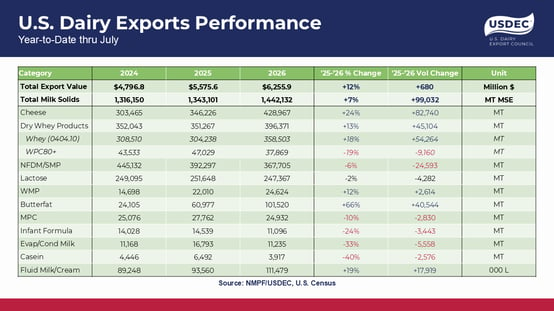
Year-over-year (YOY) U.S. dairy exports fell for the second straight month in July in a mixed bag of category-by-category results. While products like cheese and butterfat extended their growth streaks, tight exportable supplies of dairy proteins continued to limit U.S. participation in whey protein concentrate (low- and high-protein WPC) and nonfat dry milk/skim milk powder (NFDM/SMP) markets.
U.S. exports fell 2% in milk solids equivalent (MSE) terms compared to the previous July. YOY export value jumped 11% to $950 million. The July numbers put year-to-date MSE export volume up 7% and value up 12%.
Cheese extends growth
On the positive side, U.S. cheese shipments continued to soar. July exports rose 25% to 65,256 MT, a new monthly high. All major destinations posted double-digit gains: Mexico +28% (+4,914 MT); South Korea +34% (+2,052 MT); Australia +59% (+2,006 MT); South America +70% (+1,553 MT). Smaller markets expanded similarly.
Exports to the UAE recorded the largest YOY decline in July (-86%, -427 MT), but U.S. suppliers continue to find alternative paths to market, primarily through Saudi Arabia. A YOY 89% increase (+713 MT) to Saudi Arabia helped lift cheese exports to the Middle East by 19% (+327 MT).
Butter stumbles
Overall U.S. butterfat exports (butter and anhydrous milkfat or AMF) rose for the 26th straight month, but growth sharply slowed to just +1% (+166 MT). The increase was solely due to AMF gains (+23%, +873 MT). YOY butter exports fell for the first time since May 2024: -8% (-706 MT).
One reason for the slowdown is that we are starting to lap stronger prior-year performances. Of greater weight, global butter supplies have been rising for some months, and the U.S. price advantage has eased. In 2025, elevated prices and extremely tight butter markets in Europe drove the atypical movement of U.S. volume to the EU, for example, with the Netherlands buying nearly 6,000 MT over the course of the year, including 1,245 MT in July 2025. By contrast, the Netherlands averaged less than 80 MT per year in U.S. butter purchases for the decade prior to 2025 and imported zero butter in July 2026. A repeat of 2025’s performance in Europe is unlikely under current market conditions.
Even though many key potential butterfat growth markets continued to show promise in July (including the Middle East/North Africa and Mexico), YOY butterfat growth is likely to be more challenging through the year-end.
Dry whey drives low-protein whey
YOY low-protein whey exports increased 19% (+8,419 MT), as dry whey shipments remained scorching hot. The low-protein whey category comprises three HS Codes: dry whey, low-protein WPC, and modified whey. U.S. low-protein WPC exports have struggled all year as processors opted to make higher protein products (WPC80+) to satisfy seemingly insatiable U.S. and global demand (see USDEC’s half-year trade analysis here). YOY low-protein WPC exports fell 28% in July (-3,719 MT). (And even with manufacturers prioritizing high-protein whey production, rabid U.S. demand is similarly limiting U.S. WPC80+ exports, which fell by 11% (-774 MT) in July and were down 19% year to date.)
Dry whey, however, remains on track to easily surpass a15-year-old annual record. YOY U.S. shipments of dry whey soared 76% in July (+12,328 MT), and year-to-date shipments were up by more than 50% (greater than 120,000 MT). In July, YOY exports to China doubled (+6,042 MT); shipments to Canada rose 353% (+4,171 MT); and exports to Japan jumped 508% (+971 MT).
NFDM/SMP struggles
Elevated prices and low exportable supply continues to dog NFDM/SMP. Exports fell 19% (-11,325 MT) in July. For the U.S., performance is a matter of supply and unfavorable pricing. As implied by the results of this this week’s Global Dairy Trade auction (where SMP prices jumped 5.3% to their highest level in four years), global SMP demand is currently strong.
 Note: USDEC adjusts whey volumes to account for misclassified products shipped to China.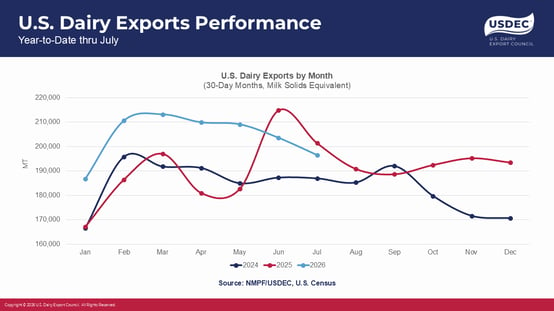
Learn more about global dairy markets
- U.S. export growth streak runs to seven months
- March makes it six straight months of year-over-year export growth
- U.S. extends dairy export growth streak in February
- Dairy exports start strong in 2026
Subscribe to the U.S. Dairy Exporter Blog
*Clarification, Sept. 22, 2026: Updated to reflect corrected trade figures.
The U.S. Dairy Export Council fosters collaborative industry partnerships with processors, trading companies and others to enhance global demand for U.S. dairy products and ingredients. USDEC is primarily supported by Dairy Management Inc. through the dairy farmer checkoff. How to republish this p