.png)

-
Our economics team examines key factors that will influence dairy markets and trade over the coming year.
2025 was a year of transition for the dairy industry, both in the U.S. and across the globe. Over the course of the year, we watched milk production accelerate while dairy commodity prices buckled under the weight of hefty supplies. Meanwhile, despite extreme uncertainty in the trade policy arena, global dairy demand continued to advance while the U.S. further entrenched itself as the fastest-growing exporter.
But now, 2026 has arrived and as we embark upon the new year, our perspective has shifted from reflection to anticipation. What lies in store for the industry this year? Will the same factors that influenced markets and trade in 2025 persist into the coming months?
As we seek the answers to these questions, our economics team has undertaken our annual “Signposts” exercise through which we identify and examine key factors that will influence dairy markets and trade over the coming year. Please read on to see what key questions we believe will guide the market in the coming year, beginning with…
Will U.S. milk continue to abound?
U.S. milk production grew 2.8% in liquid terms in 2025, the largest annual jump in 20 years. Once adjusted for rising component levels, the increase is expected to be an even more impressive 3.7%. Production growth in 2025 dwarfed that of prior years, as producers prepared to fill new processing capacity, capitalized on strong margins at the start of 2025, and responded to record-high beef prices, which incentivized them to hold onto cows for an extra lactation. These factors drove the U.S. dairy herd to nearly 9.6 million cows in 2025, the largest number in 30 years. But will producers be able to keep up the pace in 2026?On the one hand, lower margins are expected to dampen enthusiasm for production growth. All the milk that made its way to vats and churns turned up in additional volumes of cheese and butter—and put downward pressure on commodity prices and, in turn, milk prices. The all-milk price has retreated from the record highs witnessed in 2024, and even as feed costs remain affordable, producer profitability has come under pressure. The milk margin over feed cost metric reported as part of the Dairy Margin Coverage program is expected to remain below the $9.50/cwt. threshold at which payments begin for the first half of 2026.
Typically, these margin levels would encourage producers to trim their herds and rein in milk production. However, the sale of crossbred calves is muting the impact of low prices and may delay a supply reaction. As a result, even though milk margins are indeed weak and many producers are feeling the pain, the expected contraction in milk production will likely be delayed, and milk is expected to remain relatively abundant, at least through the first half of 2026.
But the phenomenon of rising milk production has not been limited to the U.S., leading us to ask…
How much milk is in store worldwide?
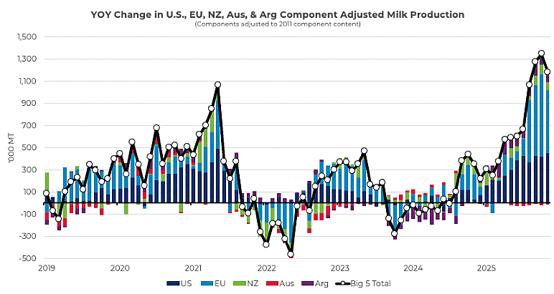
After three-plus years of weak overall growth from the Big 5 suppliers—Argentina, Australia, the EU27+UK, New Zealand and the United States—milk production has surged. Calendar-year output from the group rose less than 1% annually from 2021-2024 (and even contracted two of those years). Since April 2025, however, production grew a whopping 3.7%, boosted by good weather and a favorable relationship between milk prices and input costs. Year-over-year gains between August and November exceeded 4%—a threshold not breached since 2021—with elevated growth carrying into the new year.An old rule-of-thumb states that global dairy demand growth can only support about a 1.5% annual increase in milk production growth from the world’s major exporters. Greater-than-1.5% leads to oversupply and price erosion. With milk production growth running meaningfully ahead of this benchmark, it is clear that we’ve quickly entered a period of global oversupply, with the question now becoming, how long will this elevated growth continue?
Excess production is indeed taking a toll on milk prices, and there is no doubt that declining raw milk prices will dampen production momentum, but that process is likely to be inconsistent across geographies. And it won’t happen tomorrow.
In fact, price declines in New Zealand, Europe and parts of South America in the back half of 2025 failed to inhibit growth through November. In New Zealand, good pasture conditions, affordable supplemental feed, and a surprising jump in dairy commodity prices at the start of this year (which will at least temporarily put the brakes on farmgate price erosion), have the country well-positioned for a strong finish to the 2025/26 season. Plus, the Northern Hemisphere spring flush is just around the corner.
The Big 5 producers haven't exceeded 1.5% milk production growth in a calendar year since 2017. While year-over-year growth should soon ease from the current sky-high rates of +2% to +4% per month, oversupply remains the concern of the day.
With milk production plentiful both in the U.S. and across the world, it seems clear that product availability will not constrain global dairy trade in the coming months. But how will demand fare? After a volatile 2025, we anticipate global dairy demand will grow moderately this year as economic factors stabilize. But certain geographies come with more doubts than others. To delve more deeply into demand prospects, let’s start by considering…
Can Southeast Asia rebound?
One of the more disappointing dairy import performances in 2025 came from Southeast Asia (SEA). Even as we wait for December data, aggregate dairy shipments to the region were essentially flat in 2025. That’s an issue for dairy trade because, taken together, the six largest economies in the region—Indonesia, Malaysia, the Philippines, Singapore, Thailand and Vietnam—alternate with China as the largest importing market in the world.Last year was particularly disheartening because SEA appeared on the road to dairy import recovery after a strong 2024 in which volume rose 6% in terms of milk solids equivalent (MSE). High inflation that undercut demand in 2022-2023 had come under control and regional economic growth was strong, fueling a rebound in consumer demand.
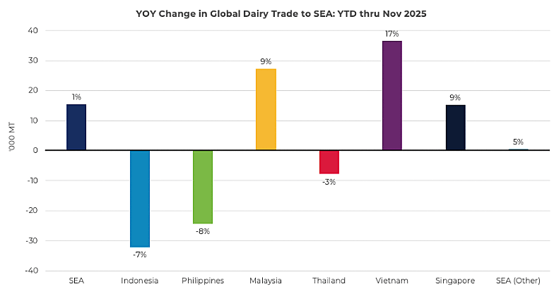
Those same low-inflation, solid economic growth conditions held through 2025, but import demand growth lagged, particularly for ingredients. SEA remains a very price-sensitive market. Even as inflation fell and incomes rose, elevated international pricing for key commodities like SMP, WMP and low-protein whey weighed heavily on demand, especially earlier in the year.
Looking to 2026, underlying fundamentals look relatively strong. Analysts are projecting inflation between+2.2% and +2.9%—the best since 2022—and GDP growth of around 4.4% led by Indonesia, the Philippines and Vietnam. In other words, economic growth within the range of recent annual gains.
The big differentiator at the start of 2026 from a Southeast Asian demand perspective is international commodity pricing. The global milk oversupply has seen key dairy products purchased by Southeast Asian buyers drop to multi-year price lows. There’s been little relief for low-protein whey. But prior to the most recent Global Dairy Trade auctions, New Zealand SMP and butter prices had fallen to two-year lows. European SMP prices hadn’t been at current levels since spring 2020.
The region hasn’t seen dairy import demand factors this bullish in quite some time.
And there was at least one bit of good news from 2025 that should carry over: as was the case in much of the rest of the world, Southeast Asian cheese demand boomed last year. In fact, major supplier exports to the region were on track for a record through the first 10 months, driven by a growing demand for cheese and a revived foodservice sector. SEA, in fact, is gaining on Mexico to join the list of the top five cheese importers in the world.
With Southeast Asian demand poised to get back on track and milk production rising the world over, the region will likely continue to be a source of fierce competition for global suppliers. While the U.S. is well-positioned to pick up a portion of this growing demand, we also want to consider which other geographies can drive growth. This leads us to question…
Will Mexico remain an engine of growth for U.S. dairy exports?
Were we to travel back in time to the beginning of 2025, we would find ourselves staring down an uncertain future for Mexico as a trading partner. Mexico has long been the largest export market for U.S. dairy products, and the size, scope, and integration of the market is undeniable. However, early last year it seemed that tariff threats and flaring tempers were poised to undermine the United States’ relationship with this crucial market.But now, one year into the future, that fear seems to have been largely misplaced, as U.S. dairy exports have continued to move across the border at a healthy clip. Over the first 11 months of 2025, U.S. exporters sent 589,208 MT of dairy products to Mexico in MSE terms. While down a modest 1% (-6,535 MT MSE) from 2024’s record high levels, this remains the second largest volume ever posted for the period.
If anything, Mexico’s role as the chief destination for U.S. dairy exports has been galvanized. With one month of data outstanding, Mexico accounted for 28% of U.S. dairy exports in 2025. Even more impressive, over the past decade, a whopping 61% of the growth in U.S. exports can be credited to Mexico. While only one thread in a broad tapestry of destinations, it is clear that robust dairy demand in Mexico wields enormous influence over total U.S. dairy exports. But will this trend persist into the future?
There are reasons to be optimistic about the future of Mexican demand. After stumbling in 2025, the Mexican economy is expected to recover and expand during the coming years. The International Monetary Fund is currently forecasting GDP growth of 1.5% in 2026, and while this figure feels low by historical standards, it nevertheless represents an important improvement versus prior year. On a related note, inflation is also predicted to slow to 3.3%, which, if realized, would be the lowest reading since 2016 and would play an important role in boosting consumer purchasing power. Tourism has remained resilient, reaching record high levels in 2025 with further gains forecast for 2026, especially across FIFA World Cup host cities. More visitors will support higher dairy consumption, particularly through foodservice channels.
Of course, challenges persist. Remittances, which account for more than 3.5% of Mexico’s economic activity, tumbled in 2025 in response to tighter U.S. immigration policy. This year, remittances are expected to fall further, exacerbated by a new taxation scheme that went into effect on January 1. The peso is also expected to weaken modestly in 2026. Despite a barrage of destabilizing events, the peso surprisingly appreciated more in 2025 than it has at any time in the last 30 years. Moderation of the exchange rate this year will mean that Mexican buyers will have to lay out relatively more pesos to buy dollar-denominated goods.
Beyond economic considerations, political relations between the U.S. and Mexico remain precarious, while broader geopolitical events in Latin America could exert further pressure on this dynamic. The review of the U.S.-Mexico-Canada Agreement (USMCA) will also begin this year, and while dairy trade between the United States and Mexico specifically shouldn’t be a major sticking point, any proposed changes to the agreement could have reverberations for the industry. The risks are rife, but Mexico remains an irrefutably critical partner of the U.S. dairy industry and is poised to continue forming a cornerstone of growth for exports into the future.
With key destinations poised to regain traction in 2025, we also want to consider what shape the U.S. export product portfolio will take. Cheese had a banner year in 2025, with exports soaring to record high levels and continued strong performance expected this year. But what about some less expected products? Specifically…
Will the U.S. continue to export butterfat?
While butter and anhydrous milkfat (AMF) aren’t typically large export products for the U.S., 2025 saw huge gains in both, with butter exports growing 153% (+44,105 MT) and AMF exports growing by 166% (+20,850 MT) over the first 11 months of the year. The strong milk production growth mentioned in our first Signpost combined with soaring fat tests led to a 4.1% increase in milkfat availability during 2025. This bolstered the availability of butter, butter blends and AMF, while competitive pricing of U.S. products created a favorable environment for export growth.All things considered, milk and milkfat supply will likely continue to be ample at least through the first half of 2026. Slightly higher feed prices could lead to changes in rations, which may reduce milkfat production marginally. However, genetics are less malleable, meaning milk and milkfat production per cow will likely remain elevated throughout 2026. Upbeat milkfat production is likely to keep butter and AMF production positive, allowing for more product potentially available for the international market.
But another consideration is domestic demand—if U.S. markets need additional milkfat, less will be available for export. Foodservice, which uses a significant amount of high-milkfat products like cheese and butter, struggled throughout 2025 as many consumers felt squeezed by elevated prices. While consumers have shifted some foodservice demand towards retail, moderate dairy retail volume growth in 2025 (1.9%) has not been able to absorb the additional milkfat production. With high milkfat production expectations and lukewarm domestic demand, U.S. markets will likely have available butterfat for export in 2026.
Importantly, U.S. milkfat exports have benefited from a significant price advantage compared to the EU and New Zealand of around $1/lb. throughout 2025. Continued price competitiveness will play a key role in enabling U.S. butterfat exports over the coming year, but strong 2026 milk production from both competing markets threatens to reduce this advantage. While time will tell if relative pricing dynamics play out in favor of the U.S., from a supply perspective, the U.S. appears well-positioned to continue growing exports of butter and AMF this year, providing a critical outlet for domestic production.
Subscribe to the U.S. Dairy Exporter Blog
The U.S. Dairy Export Council fosters collaborative industry partnerships with processors, trading companies and others to enhance global demand for U.S. dairy products and ingredients. USDEC is primarily supported by Dairy Management Inc. through the dairy farmer checkoff. How to republish this post.