HIGHLIGHTS: JULY 18, 2025
• USDEC submits comments for ITC nonfat investigation
• Tariff update, U.S.-Indonesia agree on deal
• U.S. defends dairy ahead of UN non-communicable disease declaration
• USDEC commends nomination of chief ag negotiator
• USDEC meets with Brazilian food and beverage delegation at IFT
• Ingredient workshops in El Salvador, Honduras
• Member opportunity: USDEC pavilion at Gulfood 2026
• Member opportunity: USDA trade mission to Mexico
• USDEC 2025 event calendar
• Market Summary: GDT surprises with a gain
• FrieslandCampina enters Fonterra bidding
• Kraft Heinz explores break-up
• Company briefs: Unilever, Junlebao, Rupp, 21st.Bio, Ben & Jerry’s
Featured
USDEC submits comments for ITC nonfat dry milk investigation
USDEC and NMPF submitted joint comments and prehearing testimony to the International Trade Commission (ITC) regarding its ongoing Section 232 investigation into U.S. competitiveness of nonfat milk solids. The nearly 60-page document outlines dairy ingredients and their value to the U.S. dairy industry and explores how certain trading partners employ policies that distort nonfat milk solids production and, subsequently, trade in those products.
The biggest focus is placed on Canada, whose distortionary policies are having the most significant impact on U.S. competitiveness and global trade.
“Canadian government policies that drive unsustainable surpluses are coupled with extensive industry subsidization and a complex pricing structure that leads to artificially low-priced products pushed out into the international market,” the comments state. “The egregiously anticompetitive nature of the Canadian policies harms American suppliers by undercutting U.S. prices globally while simultaneously denying market access into Canada, both of which are clear contraventions of its trade agreements and international trade rules.”
The comments devote nearly 17 pages to “Canada’s long list of trade-distorting measures.” Additional sections cover the EU, India and Turkey, as well as barriers to U.S. exports. They urge the U.S. to hold Canada accountable during the 2026 U.S.-Mexico-Canada Agreement (USMCA) review process, devote attention to India and Turkey, and consider a deeper investigation into the EU.
EU and others prep retaliatory tariffs while continuing trade talks; U.S. strikes trade deal with Indonesia
U.S. plans for tariffs, trade deals and responses from U.S. trading partners continue to evolve almost daily. Last weekend, President Trump threatened to impose additional 30% tariffs on the EU and Mexico on Aug. 1, adding them to a list of countries singled out by presidential letters during the week (see Global Dairy eBrief, 7/11/25).
This week, the United States and Indonesia said they reached a deal on trade that would eliminate tariffs on U.S. goods while lowering the threatened U.S. tariffs on Indonesian goods from 32% to 19%. Similar to previously announced deals with the UK and Vietnam, details of the agreement have yet to be released.
Here’s a rundown of other developments with some key trading partners:
Mexico
Mexican President Claudia Sheinbaum said she was confident the country would strike a deal by the deadline, but if an agreement remained out of reach and the U.S. proceeded with higher tariffs, Mexico would take action. “We have to prepare for every scenario,” she said. In addition, she said the country would announce measures next week related to new U.S. tariffs on Mexican tomatoes.
In support of a potential solution, the U.S. and Mexico established a new permanent task force last Friday to address migration, security, water management, the economy and other key issues. Its first major task is to find an alternative to the tariffs and, according to the Mexican government, “protect jobs on both sides of the border.”
European Union
The EU delayed countermeasures that were set to go into effect July 14 and said its preference is to reach a deal with the United States and prevent escalation of a tariff war. At the same time, the bloc is preparing a response should talks fail to deliver an agreement.
The EU released a retaliatory tariff list of $84 billion in U.S. products, including about $7 billion worth of agricultural and food products. European officials are reportedly debating what would trigger those tariffs and whether they need to go further with additional measures that could put levies or restrictions on American services as well.
Among the products included in the EU’s “rebalancing measures” are certain dairy items and dairy-containing categories. The EU did not specify the level of duties, but the following HS Codes were among those named:
- Lactose under 17021100 and 17021900.
- Food preparations for infant use under 19011000.
- Sauces and preparations under 2103.90.90.
- Protein concentrates and textured protein substances containing greater than 1.5% milkfat under 2106.10.80.
- Food preparations under 2106.90.98.
- Casein under 3501.10.
- Caseinates under 3501.90.
- Milk albumin for human consumption under 3502.20.91 and 3502.20.99.
- Concentrated milk proteins (+85%) under 35040010.
- Several chocolate and confectionery tariff lines.
Others
Several additional countries continue to comment on emerging trade developments with the U.S. South Korea said it may be possible to strike a deal “in principle” by the Aug. 1 deadline and signaled that it may be open to allowing the U.S. greater access to its agricultural markets.
Brazil said it would utilize a new tariff reciprocity law enacted earlier this year should negotiations with the United States fail and the U.S. follows through on planned 50% tariffs on Aug. 1. Brazilian President Luiz Inácio Lula da Silva stated that the law, in this case, opens the door to 50% tariffs on U.S. goods.
Canada delayed a July 21 negotiation deadline for potential adjustments to duties on steel and aluminum imports. The new deadline is also Aug. 1. While Prime Minister Mark Carney said his country would continue to negotiate with the U.S. toward a trade deal, he also admitted for the first time that some level of U.S. tariffs on Canadian products would likely remain in place.
USDEC continues to update its members-only Tariff Tracker, which provides country-by-country information about the status of tariffs, as the situation changes. Please contact Tony Rice (trice@usdec.org) with any questions. (New York Times, 7/16/25; Reuters, 7/16/25, 7/15/25, 7/14/25; Supply Chain Dive, 7/15/25; Wall Street Journal, 7/15/25, 7/14/25; Bloomberg, 7/13/25)
USDEC defends dairy ahead of UN declaration on non-communicable diseases
As preparations ramp up for the UN’s Fourth High-Level Meeting on Non-Communicable Diseases, scheduled for Sept. 25, 2025, USDEC is working to shape the final Political Declaration to ensure it accurately reflects the nutritional value of dairy.
In response to concerning language in the zero draft of the Political Declaration, USDEC signed onto an open letter joining a global coalition in urging UN negotiators to distinguish between harmful industrially produced trans fats and naturally occurring trans fats found in dairy and meat. The letter also emphasizes the critical role that dairy plays in the diets of populations in low- and middle-income countries, where undernutrition and limited access to affordable, nutrient-dense foods remain pressing challenges.
A blanket call to eliminate all trans fats, the letter warns, risks undermining global nutrition and food security goals.
Beyond the letter, USDEC has submitted formal comments through the UN’s consultation process, engaged directly with U.S. government negotiators, and coordinated closely with global partners such as the International Dairy Federation (IDF) and Global Dairy Platform (GDP). These collective efforts are essential to promoting dairy’s role in healthy diets and defending against potentially trade-disruptive proposals that could be adopted in the final Political Declaration.
The efforts seem to be having an impact. A revised draft of the Political Declaration that was circulated this week now rightly focuses removal efforts on industrially produced trans fats and includes more inclusive, balanced language on the role of the private sector. Unfortunately, subjective language remains around saturated fat reduction efforts and taxation of sugar-sweetened beverages that could unjustifiably target dairy products.
Going forward, we will continue to work with U.S. government negotiators, global dairy allies and international partners to encourage the removal of arbitrary language and the retention/inclusion of text that better reflects dairy’s role in healthy diets.
USDEC commends nomination of Callahan as chief ag negotiator
USDEC, along with NMPF and the Consortium for Common Food Names (CCFN), applauded the nomination of Dr. Julie Callahan as the new chief agricultural negotiator for the USTR. Callahan currently serves as the assistant USTR for Agricultural Affairs and Commodity Policy and has previously held leadership positions with the USTR and FDA, as well as early career experience with the USDA’s Foreign Agricultural Service and the American Chemical Society.
“Dr. Callahan’s nomination today is a win for U.S. agriculture,” said Krysta Harden, USDEC president and CEO, in a joint press release on the nomination. “The U.S. dairy industry depends on a proactive trade policy agenda to grow. Dr. Callahan brings deep trade policy expertise and an unmatched record of advocating for U.S. farmers and food manufacturers to a role vital to ensuring agriculture has a seat at the negotiating table.”
USDEC urged the Senate to quickly confirm Callahan.
Brazil delegation meets up with USDEC at IFT
A Brazilian delegation of food and beverage processors attended the 2025 IFT FIRST Annual Event and Expo, which took place July 13-16 in Chicago. USDA Foreign Agricultural Service staff accompanied 13 individuals representing 12 Brazilian companies to the event.
On July 14, USDEC’s Terri Rexroat, vice president, Global Ingredients Marketing, met with the group to offer background on USDEC and provide information on the processor and trader members that were exhibiting at the show. Some in the delegation already source U.S. dairy ingredients but others were less familiar with the U.S. as a dairy ingredient supplier. All expressed interest in learning about opportunities from USDEC members exhibiting at the show.
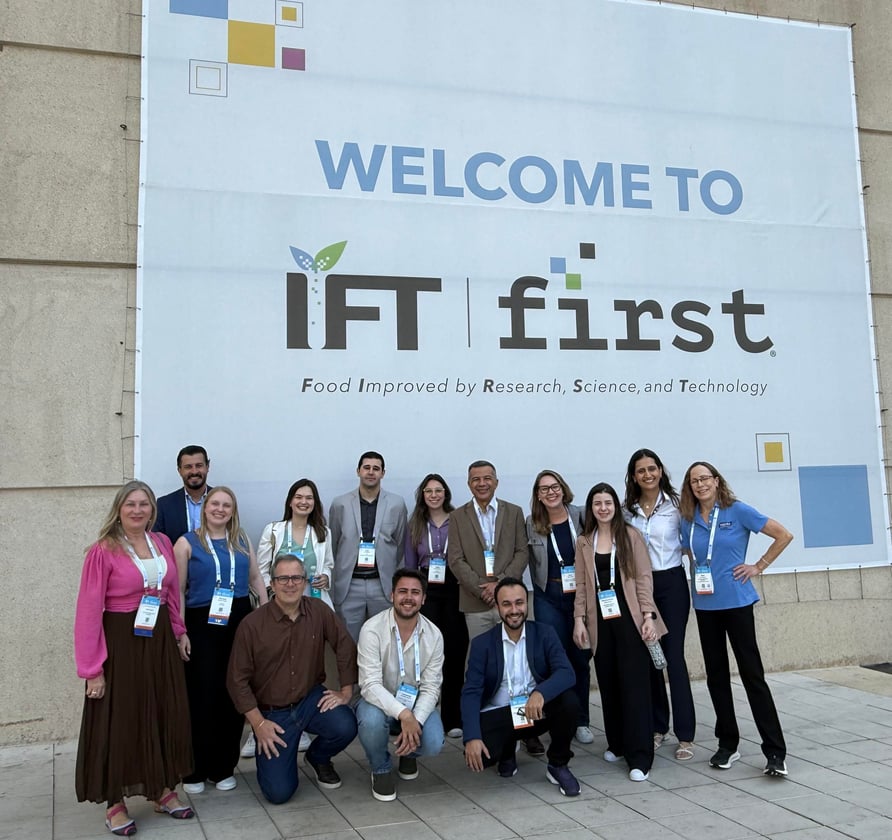
USDEC’s Terri Rexroat (far right) with the Brazil food and beverage delegation at this year’s IFT show in Chicago.
RAPP-Funded Central America workshops train local cheesemakers on U.S. dairy ingredients benefits
USDEC’s popular and long-running ingredient workshop series continued in Central America in June and July with three events in El Salvador and two more in Honduras. All the events provided classroom and hands-on instruction on incorporating U.S. milk powder and milk proteins (MPC70) into the production processes for native fresh cheeses.
Seventy-eight cheesemaking professionals attended the El Salvador workshops, which were held in Sonsonate on June 27-29 and hosted by Altezza, a Salvadoran dairy ingredient distributor and producer of cheese and cream. Fifty-one took part in the Honduran events, held July-3-4 at UNITEC University in Tegucigalpa.
Attendees learned about the performance, quality and cost benefits of incorporating U.S. milk powder and MPC70 into the cheesemaking process. The images below highlight their strong interest in the events.
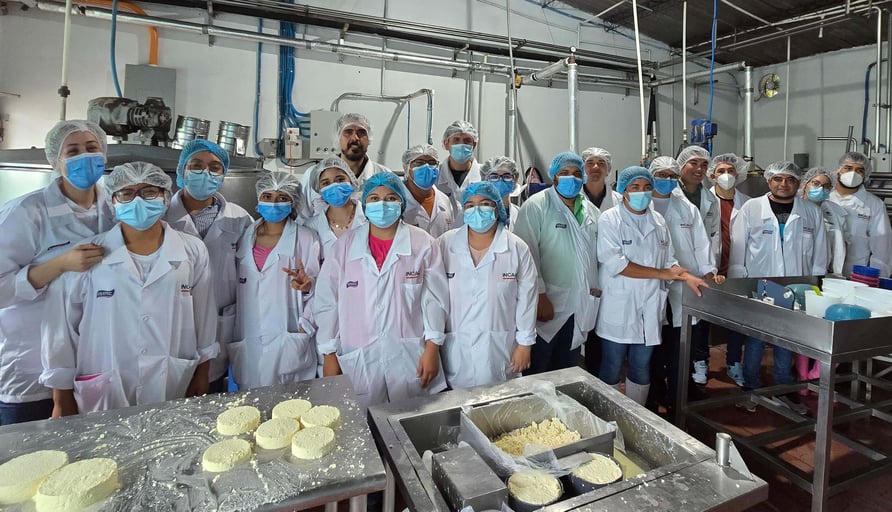
One of the El Salvador classes poses with finished cheeses made with U.S. dairy ingredients.
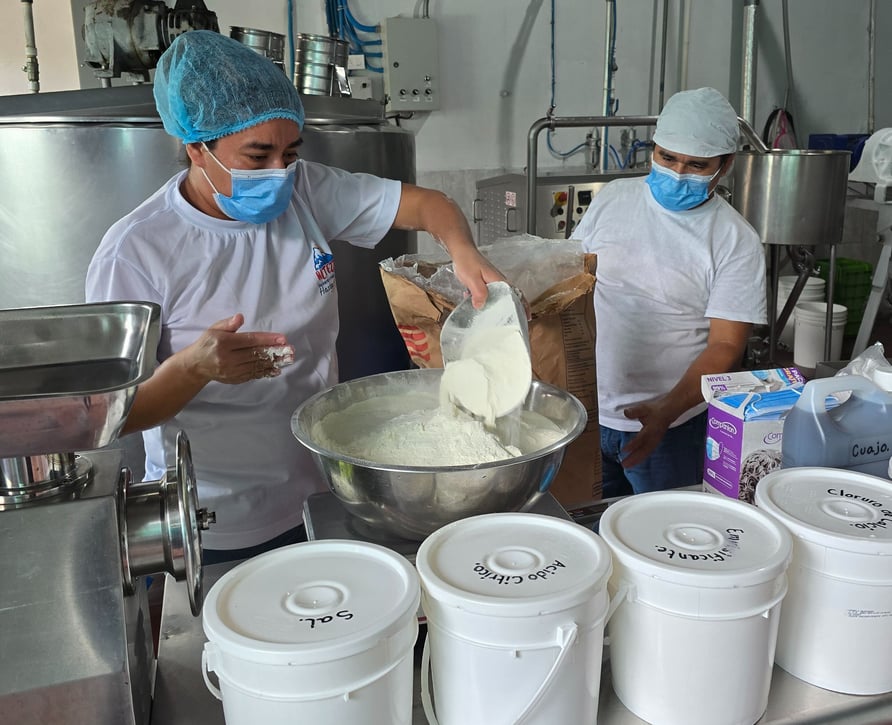
Mixing in dry U.S. dairy ingredients in El Salvador.
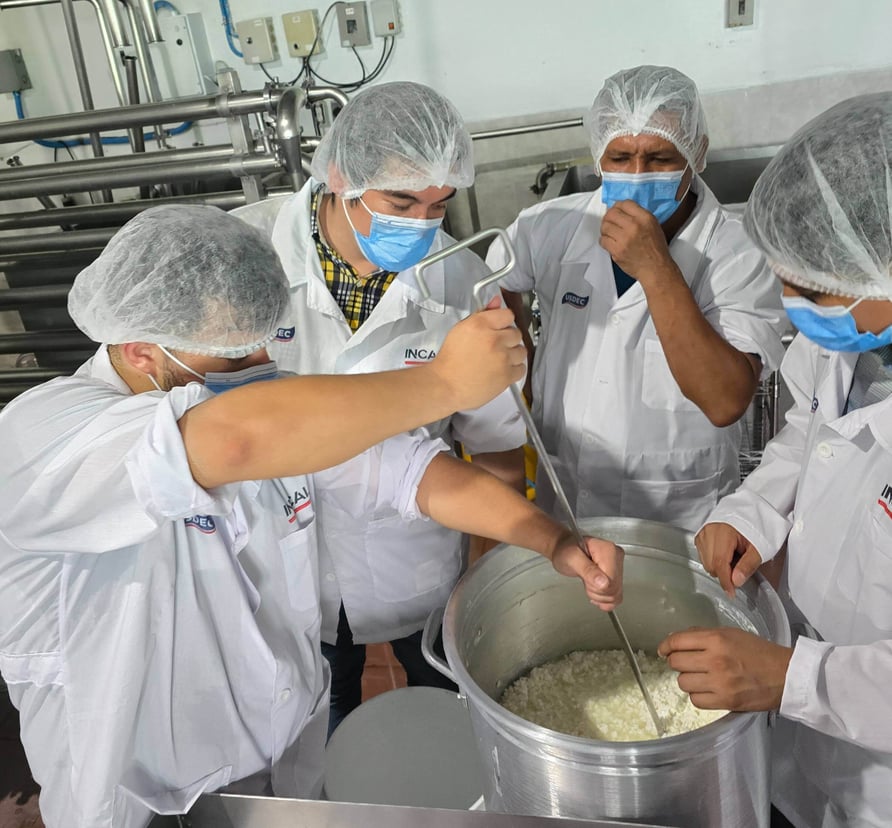
Stirring curd in El Salvador.
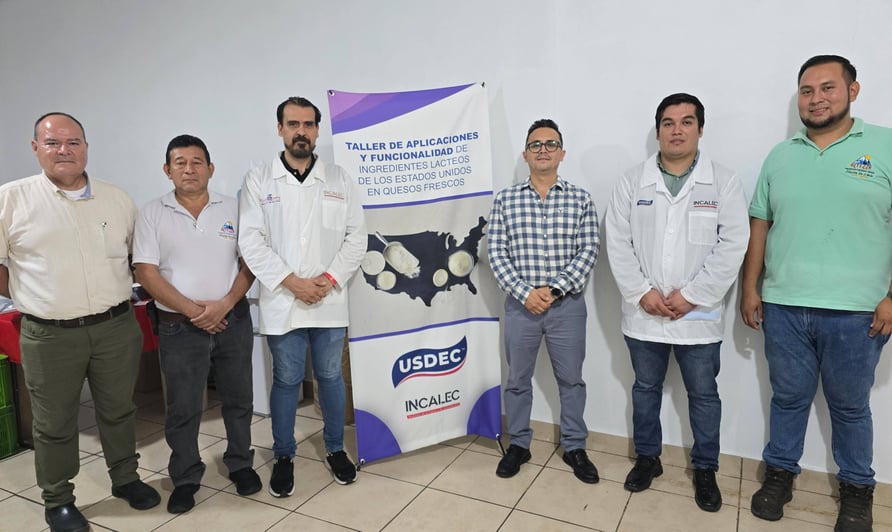
Workshop leaders in El Salvador (left to right): trainer Marco Delgado, INCALEC ; Leonel Escobar, owner of Altezza; Alejandro Gutierrez, INCALEC; Javier Roldan, USDEC Mexico; Carlos Beltran (workshop trainer); and Oscar Escobar, Altezza production manager.
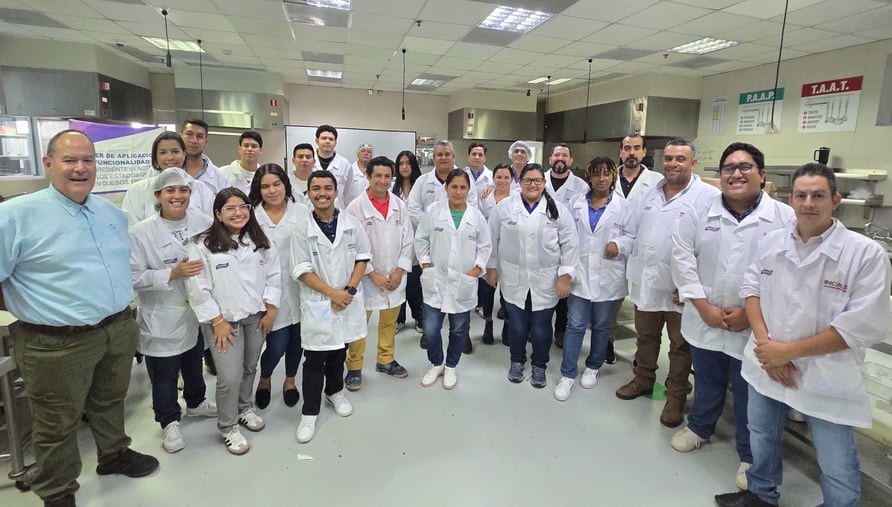
One of the classes from Honduras.
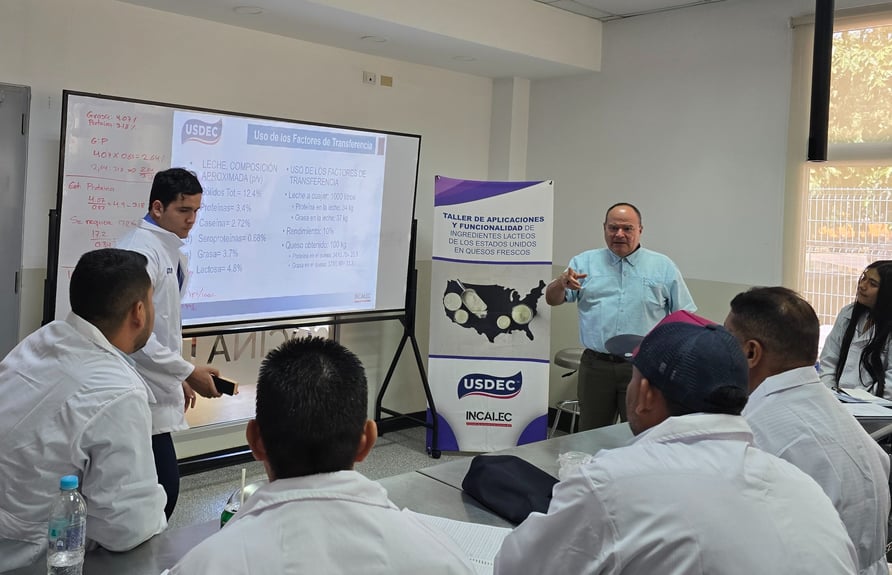
Marco Delgado conducting classroom training in Honduras.
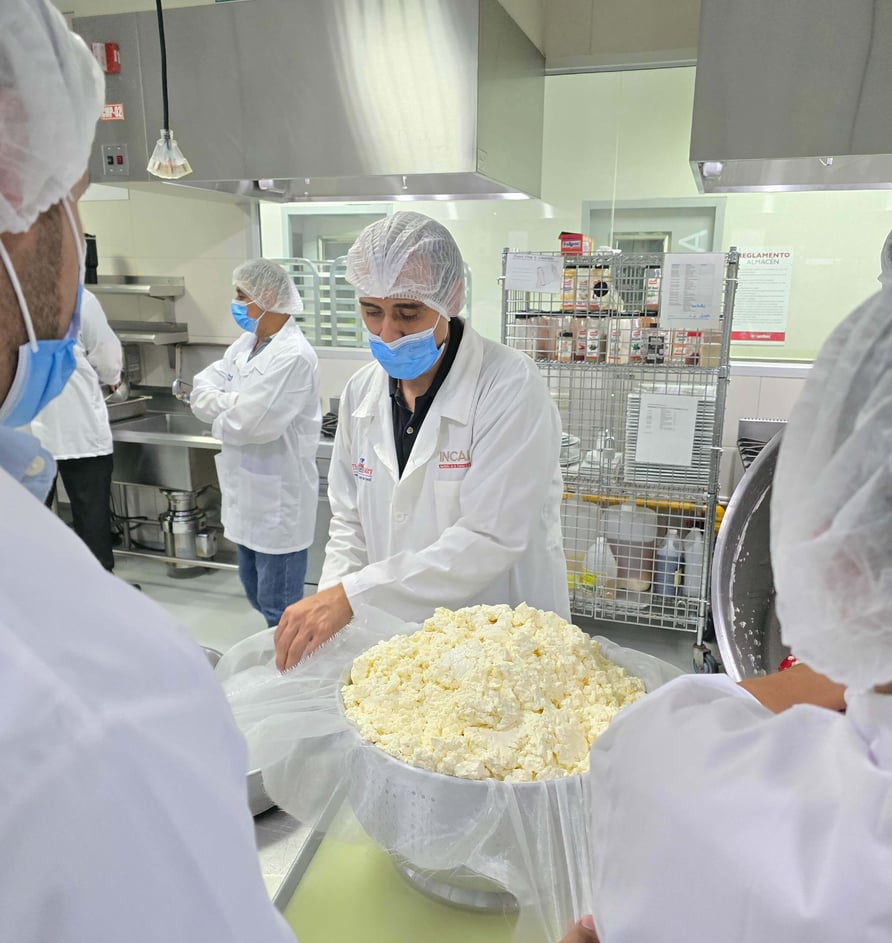
Straining curd in Honduras.
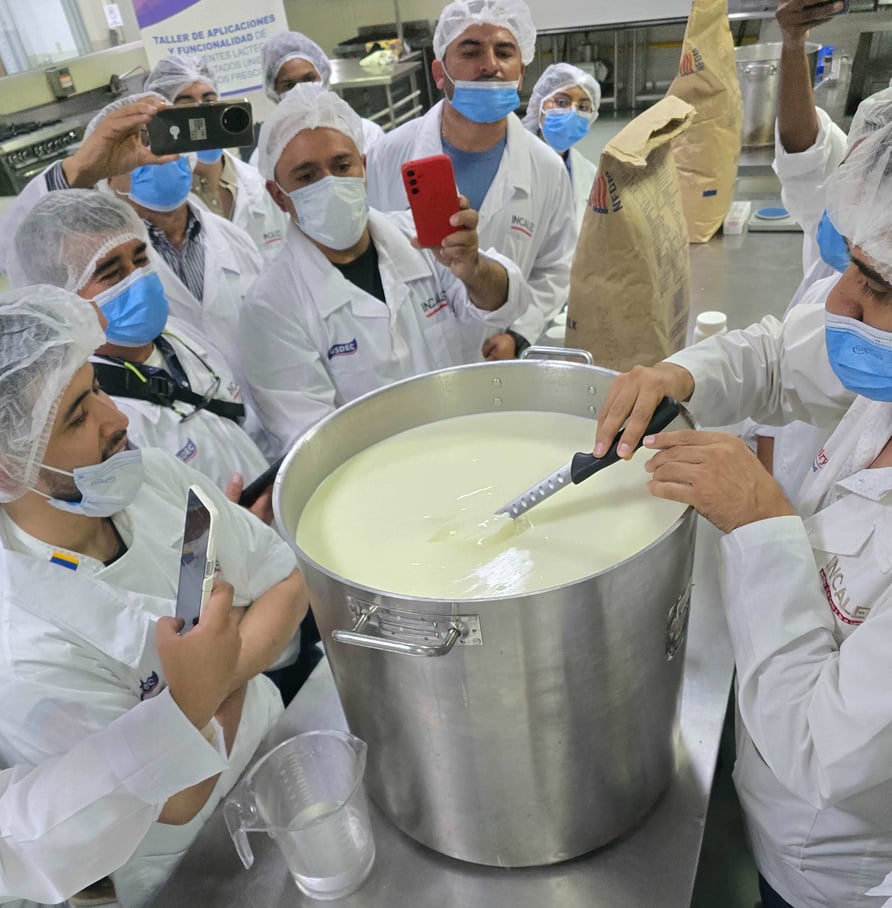
Trainees record on their phones to help them duplicate results back at their companies.
Events
Registration open for USDEC’s USA Cheese & Dairy Pavilion at Gulfood 2026
USDEC will host a USA Cheese & Dairy Pavilion at Gulfood 2026, which takes place Jan. 26-30, 2026, at the Dubai World Trade Centre in Dubai, UAE. We will have 18 booths available to members, and a lottery system will determine spots. Registration for the lottery closes on Friday, Aug. 1, so any member company interested in participating within USDEC’s USA Cheese & Dairy Pavilion should contact Nuhami Alemu (nalemu@usdec.org) for additional details and instructions.
USDA accepting applications for Mexico agribusiness trade mission
USDA’s Foreign Agricultural Service (FAS) is inviting U.S. ag exporters to participate in a Nov. 3-6 trade mission to Mexico. The mission aims to connect U.S. suppliers with key buyers from Mexico and includes business-to-business meetings, market briefings, site visits, and networking events led by FAS staff and regional experts.
For more information on the trip, including an online application form, click here. The application deadline is Thursday, July 31.
USDEC 2025 events
For your convenience, USDEC has compiled a chronological list of dairy export-related member events currently slated for 2025. This list is effective as of July 18 and will evolve as new opportunities develop, funding is finalized, or unexpected changes arise.
JULY
- Health Care Expo, Taipei, Taiwan, July 24-27
- Expo IAlimentos, Colombia, July 30-31, 2025
AUGUST
- Foodservice MENA Reverse Trade Mission, USA, Aug. 9-19, 2025
- Food Ingredients South America, Brazil, Aug. 26-28, 2025
SEPTEMBER
- U.S. Dairy Supply Seminar, Sept. 11, Ho Chi Minh City, Vietnam
- Korea, Hong Kong and Taiwan Reverse Trade Mission, USA, Sept. 13-20, 2025
- U.S. Dairy Supply and Innovation Seminar, Thailand, Sept. 15, 2025
- Food Ingredients Asia, Thailand, Sept. 17-19, 2025
- Ingredient Training Workshop-Yogurt, Cairo, Egypt, Sept. 29-30
- U.S. Dairy Innovation Seminar, Sept. 30, Ho Chi Minh City, Vietnam
- Espacio Food and Service, Chile, Sept. 30-Oct. 2, 2025
OCTOBER
- U.S. Dairy Protein Innovation Seminar, Taipei, Taiwan, Oct. 2
- U.S. Dairy Sustainability Conference: Unlocking Opportunities for Sustainable Dairy in Southeast Asia, Singapore, Oct. 7-8, 2025
- Food Tech Summit & Expo, Mexico, Oct. 8-9, 2025
- IDF World Dairy Summit, Chile, Oct. 16-25, 2025
- Ingredients Advisory Group Tactical Plan Meeting, Chicago, Oct. 21, 2025
NOVEMBER
- USDA Agribusiness Trade Mission, Mexico, Nov. 3-6, 2025
- U.S. Dairy Protein Nutrition Seminar, Nov. 4, São Paulo, Brazil
- Gulfood Manufacturing, Dubai, UAE, Nov. 4-6, 2025
- COP30, Brazil, Nov. 10-21, 2025
- Beverage Innovation Workshop, Singapore, Nov. 12-13, 2025
- Food & Hospitality China, Shanghai, Nov. 12-14, 2025
- World Cheese Awards, Bern, Switzerland, Nov. 13-15, 2025
- Mission to Market: Bulk Cheese Seminar (Japan and Korea), Nov. 17-21, 2025
- Ingredient Training Workshop-Bakery, Cairo, Egypt, week of Nov. 17, 2025
DECEMBER
- 4th Quarter Joint USDEC Meeting of the Cheese and Consumer Products Advisory Committee and the Trade Policy Committee Meeting, Washington, D.C., Dec. 10-11, 2025
Market Summary
GDT rises, defying expectations
The Global Dairy Trade (GDT) Price Index rose 1.1% at the July 15 auction, defying SGX-NZX futures indicators and GDT Pulse activity leading into the event, not to mention the trend set by the previous four auctions. The Index fell four straight auctions from May 20 to July 1, with the July 1 event marking the steepest decline (-4.1%).
A surge in Southeast Asian demand—the region accounted for 34% of volume sold, just one percentage point behind North Asia’s (China’s) total—helped lift prices. Southeast Asia led all SMP, AMF and cheddar buyers and secured its highest volume since the first auction of the year on Jan. 7, 2025. Buyers sought to capitalize on the recent auction price declines, but the increased purchasing from the region also roughly aligns with a similar seasonal buying spree in 2024.
Prices rose for all major products except cheese. Rising U.S. cheddar production and significantly lower U.S. cheddar prices (CME block prices fell to US$1.6250/lb. or US$3,582/MT in Tuesday trading) weighed on GDT cheddar for the second straight auction (and fourth of the last five). The average winning price plunged 5.6% to US$4,589/MT, hitting its lowest level since September 2024. Mozzarella fared better, slipping only 0.7% to US$4,760/MT.
The SMP price increased for the first time in five auctions, rising 2.5% to US$2,785/MT. While both China and Europe, the second and third biggest buyers behind Southeast Asia, purchased less product than at the previous event, they both far exceeded purchase volumes for the same auction the previous year.
China’s economy and other market notes
Here is a quick rundown of recent dairy supply and demand developments from around the world:
- Chinese economic growth slowed in the second quarter but still performed better than expected. GDP increased 5.2% as factories geared to exports took advantage of the temporary pause in U.S.-China trade tensions. First-quarter growth was 5.4%, and China’s target for the year is 5.0%, which most economists believe will be difficult to achieve given the country’s uncertain trade relationship with the United States.
The troubling aspect from the dairy export perspective is ongoing low consumer confidence that’s made consumer spending very tight and negatively affected sales of foodservice operations, beverages and other consumables. Growing signs of deflation are likely to further squeeze spending.
Analysts expect GDP growth to dip below the 5.0% target for the remainder of the year without major stimulus spending and/or economic reform.
- Lumpy skin disease was detected in Italy and France for the first time. While it does not pose a threat to human health, it does raise another potential headwind for EU milk deliveries. The condition, which is widespread in North Africa, can reduce milk production, cause weight loss, and impair reproduction.
- Earlier this month, Turkey shut all livestock markets to control the spread of foot-and-mouth disease (FMD) after detecting a new serotype. It said it would gradually reopen animal trade after a mass vaccination program. Officials claimed the closures would not affect dairy supply and demand. (Reuters, 7/15/25, 7/9/25, 7/2/25; Bloomberg, 7/14/25; Dairy Global, 7/8/25)
Company News
Bega partners with FrieslandCampina in bidding for Fonterra businesses
Australia’s Bega Cheese joined forces with Dutch dairy giant FrieslandCampina to acquire Fonterra Co-operative Group’s Mainland Group, which is composed of its consumer and foodservice businesses and Sri Lankan operations. Previously, reports were that Bega had been interested in a solo bid for the businesses, calling itself the “natural acquirer” for the operations.
The Bega-FrieslandCampina consortium is reportedly up against Japan’s Meiji Holdings and France’s Lactalis, which recently secured Australian Competition and Consumer Commission (ACCC) regulatory clearance to pursue the purchase (see Global Dairy eBrief, 7/11/25). All three submitted bids earlier this month, but a second round of bidding could take place in the coming weeks. (Inside FMCG, 7/16/25; Food & Drink Business, 7/15/25)
Kraft Heinz exploring a potential breakup
The Kraft Heinz Co. is reportedly considering spinning off a large part of the grocery foods business it acquired with the 2015 merger of The H.J. Heinz Co. and Kraft Foods. The goal of such a move would be to streamline operations and focus investments on higher-margin products. Analysts said the potential split would likely involve spinning off a large part of its business into a new entity while sticking with products reporting strong growth. That would likely involve focusing on its sauces, condiments, meals and snacking brands including Kraft macaroni and cheese and Philadelphia cream cheese. Products that may be spun off into a new entity include coffee, meats and other cheese, including Velveeta products. In November 2021, the company sold portions of its cheese business to the Lactalis Group and Emmi Roth USA Inc. (Bloomberg, 7/14/25; Wall Street Journal, 7/11/25)
Mergers, acquisitions and joint ventures
London-based consumer goods giant Unilever sold its Venezuelan ice cream business, including the Tio Rico ice cream brands and their office and factory, to automotive company Mack de Venezuela CA, which represents the Mack, Volvo and Dongfeng truck brands in the country. The sale was finalized July 3. … Nutrico Food Group, a subsidiary of Greek food group Vivartia, sold its Feta cheese business Dodoni to local peer Hellenic Dairies in a deal valued at approximately €205 million (about US$239 million). … As part of its strategy to expand in Europe, Austrian cheese company Rupp acquired Spain-based dairy and dairy-alternative maker Juan Martinez. Juan Martinez operates a production facility for processed cheeses, cream, and vegetarian and vegan offerings. The company will maintain its brand and workforce, and handle all Rupp operations in the region. (Just Food, 7/15/25, 7/14/25; Bloomberg News, 7/10/25)
Company briefs
China-based Junlebao Dairy is investing in a 15,000-liter ultra-high temperature (UHT) system designed to meet growing demand for its Freshjoy extended-shelf-life milk. The company expects to commission the system in September. … New Zealand boutique cheese maker Meyer Cheese is investing NZ$3.5 million (about US$2 million) in a new facility designed to boost capacity and enhance sustainability. The new facility will enable milk processing, cheesemaking, packaging, storage and delivery to come under one roof. … Danish bioproduction company 21st.Bio launched a new program to commercialize bovine alpha-lactalbumin (alpha-lac) using precision fermentation. The new version of the protein will use a microbial strain developed by Novonesis and aims to make the alternative more cost-competitive with traditional dairy sources. … Unilever appointed Jochanan Senf as the new CEO of Ben & Jerry's, effective immediately. He was previously managing director for Ben & Jerry's Europe. His appointment follows the controversial dismissal of former CEO Dave Stever, a move the independent board of Ben & Jerry's said was executed without their consent and breaches an agreement aimed at safeguarding the brand's independence and commitment to social activism. … India’s Gujarat Cooperative Milk Marketing Federation Limited (GCMMF), which owns well-known dairy brand Amul, unveiled a new dairy federation called the Sardar Patel Co-operative Dairy Federation Ltd. (SPCDF). The new initiative aims to unite two million dairy farmers from more than 20,000 unregistered co-ops in an effort to expand the country’s dairy outputs and benefit local farmers nationwide. (USDEC China office; Rural News Group, 7/10/25; Dairy Processing, 7/11/25; FoodBev Media, 7/11/25; Food Dive, 7/11/25; Dairy News Today, 7/8/25)
In Case You Missed It...
U.S. Dairy Exporter Blog
Market analysis, research and news subscribe hereUSDEC Twitter feed
Follow us here.